
 English
 French
 Russian
 Chinese (Simplified)
 Spanish
 German


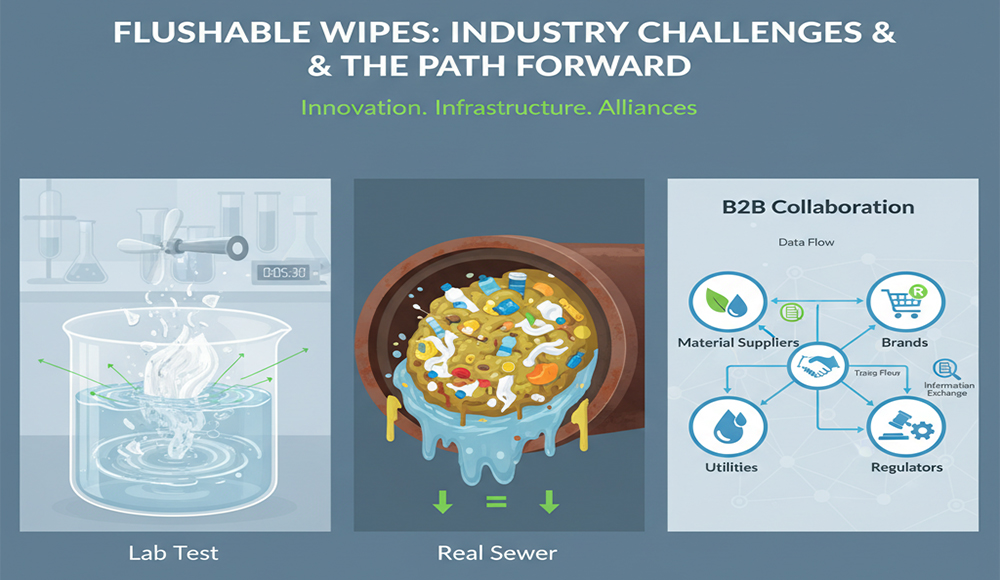
Flushable Wipes: Standard or Marketing Myth?
As demand surges and regulations tighten, the flushable wipes industry faces a critical reckoning.
Yet manufacturers, brands, and wastewater utilities are locked in growing conflict over fatbergs,
sewer clogs, and escalating maintenance costs.This raises a fundamental industry question:
Is “flushable” a meaningful performance standard — or merely a marketing label?This deep dive reveals three uncomfortable truths about flushable wet wipes,
and how forward-looking B2B suppliers like Biokleen are redefining
verified flushability for the future.
Truth 1: Lab Tests Don’t Equal Sewer-Ready Flushable Wipes
Most flushable wipes disintegration tests — including INDA’s FG502 guidelines —
simulate ideal conditions: controlled water flow, clean systems, and short timeframes.
A wipe may disperse perfectly in a beaker, yet fail catastrophically in real sewer networks,
where grease, hair, and debris combine to form fatbergs costing U.S. utilities
over $400 million annually.
The core disconnect is infrastructure reality. Municipal wastewater systems —
many over 50 years old — were never designed to handle synthetic or slow-dispersing fibers.
Even so-called “dispersible” nonwovens can generate drag, accumulation, and downstream blockages.
Truth 2: Blaming Consumers Masks a Design Failure
The industry’s default defense is familiar: consumers flush non-flushable wipes
or pour grease down drains. While partially true, this argument ignores a deeper issue.
If flushable baby wipes, intimate wipes, or makeup remover wipes only perform
under perfect laboratory conditions, the problem lies in materials science,
not consumer education.
From a B2B risk perspective, categories facing lawsuits and regulatory scrutiny
across the UK, Australia, and U.S. cities quickly become brand liabilities.
Progressive suppliers design for worst-case wastewater conditions,
not ideal scenarios.
Truth 3: Biodegradable ≠ Flushable
“Plant-based” and “biodegradable” flushable wipes sound sustainable,
but biodegradability — often measured over months — is fundamentally different
from flushability, which requires rapid dispersion within hours.
· Predictable degradation in low-oxygen, high-shear pipe environments
· No entanglement with FOG (fats, oils, grease)
· Verified performance through third-party wastewater testing
As the global flushable wet wipes market moves toward $5B+ by 2030,
only substrates meeting true flushability criteria will remain compliant
under tightening regulations.
The Regulatory Turning Point for Flushable Wipes
Regulators and wastewater authorities are no longer accepting lab-only claims.
EU policy discussions, U.S. wastewater guidelines, and municipal enforcement
are reshaping what “flushable” must legally and technically mean.
The industry is approaching a pivot point where verified system-level performance
becomes non-negotiable.
Biokleen’s Approach: Flushable as a Verified System Contract
At Biokleen, we’ve moved beyond slogans. We treat flushability
as a system-level engineering and verification challenge.
· Real-world validated flushable materials
· Fibers engineered for municipal sewer compatibility
· Binders designed to disperse under real pipe hydraulics
· INDA / EDANA-aligned testing — extended to wastewater conditions
· Transparent B2B data-sharing partnerships
Material Suppliers → Converters → Brands → Utilities
Shared data · Joint verification · Shared accountability
This approach supports future-proof compliance,
preempts EU flushability regulations,
aligns with U.S. wastewater utility expectations,
and enables plant-based flushable wipes that truly flush.
The Flushable Wipes Industry’s Pivot Point
Manufacturers should stop asking whether substrates are “flushable”
and start asking whether materials, test protocols, and communication frameworks
can withstand regulatory and infrastructure scrutiny.
Wastewater professionals should demand verified flushability certificates
backed by real pipe data — not lab screenshots.
Brands must recognize that “flushable” packaging is a system-level commitment,
not a marketing claim.
Key Takeaways
· The flushable wipes market will grow — but only verified solutions will survive.
· Lab success alone no longer defines flushability.
· System-level validation is becoming the new industry baseline.
Biokleen welcomes B2B collaboration on next-generation
flushable substrates and joint verification projects.
Contact us to start the conversation.