
 English
 French
 Russian
 Chinese (Simplified)
 Spanish
 German


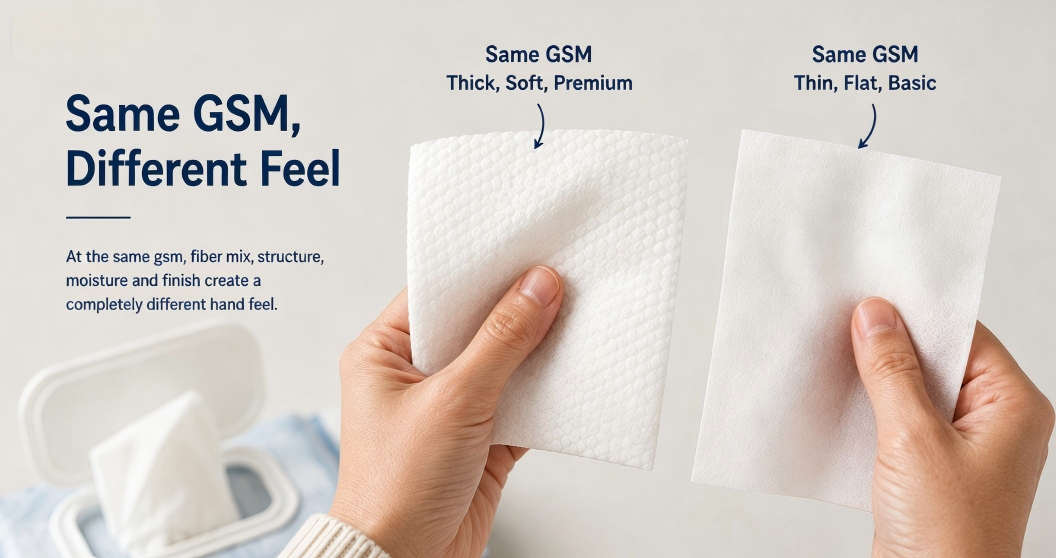
Two wet wipes may both be labeled 40 gsm, yet one feels soft, thick, and premium while the other feels flat and less refined. That difference often surprises buyers, because gsm alone does not tell the whole story.
GSM Shows Weight, Not Texture
GSM, or grams per square meter, tells you how much material is used in a given area. It does not tell you how the fibers are arranged, how compact the sheet is, or how the wipe will feel in hand.
In other words, two products can share the same gsm and still differ in thickness, density, and loft. For buyers, this means gsm is useful, but it should never be treated as the only decision-making factor.
Fiber Mix Changes the Feel
The fiber composition has a direct effect on softness and overall hand feel. Wipes with more viscose or cotton-like fibers usually feel gentler, smoother, and more comfortable for skin-contact applications.
By contrast, wipes with a higher share of polyester or polypropylene often feel firmer and more structured. This can be an advantage when strength, durability, or wet performance matters more than a cushioned touch.
Structure and Loft Matter Too
Even when the gsm stays the same, the internal web structure can make the wipe feel completely different. A looser, loftier structure traps more air and usually creates a fuller, thicker impression.
A tighter or more compressed structure tends to feel flatter and less plush. That is why two wipes with identical basis weight can still look and feel like they belong to different product tiers.
Liquid Load Changes Wet Feel
A wet wipe is not just the dry substrate; it is also the liquid formulation that is added to it. If the liquid is evenly distributed and loaded at the right level, the wipe usually feels more balanced, more cushioned, and more premium.
If the wetting level is too low, or the liquid is unevenly absorbed, the wipe may feel dry, papery, or underfilled. Moisture content is one of the most important reasons why the same dry base can perform differently after saturation.
Finishing Steps Refine the Final Touch
After the base material is made, finishing processes help define the final experience. Embossing can add texture and a richer feel, while creping or smoothing can make the wipe feel more refined in a different way.
Surface treatments may also improve softness or slip, depending on the intended application. These details do not always change the gsm, but they strongly influence how the wipe is perceived by the user.
What Brands Should Focus On
For B2B buyers, gsm is only the starting point. To select the right wet wipe, it is also necessary to review fiber ratio, thickness, moisture level, surface treatment, and production consistency.
This matters especially for brands that want a specific positioning, such as baby care, personal care, or premium private label products. In those cases, the feel of the wipe is part of the product value, not just a side effect.
How Biokleen Supports Product Development
Biokleen helps customers match the right hand feel by adjusting material blend, basis weight, liquid dosage, structure, and finishing. Instead of relying on gsm alone, we look at the full combination of material and process.
That approach helps create wipes that feel consistent, perform reliably, and fit the target market more accurately. For brands, this means better control over both sensory appeal and product positioning.