
 English
 French
 Russian
 Chinese (Simplified)
 Spanish
 German


For brands looking for a reliable wet wipes manufacturer, choosing a supplier involves much more than comparing prices. Manufacturing capacity, quality control, product development, customization and supply chain reliability can all affect the success of a wet wipes product.
At Biokleen Wipes, we combine automated manufacturing capabilities with OEM development expertise to support brands from the initial product concept and sample development to large-scale production.
Inside a Modern Wet Wipes Factory
A reliable wet wipes factory needs to do more than manufacture products efficiently. It must be able to maintain stable specifications, manage different packaging formats and support growing order volumes.
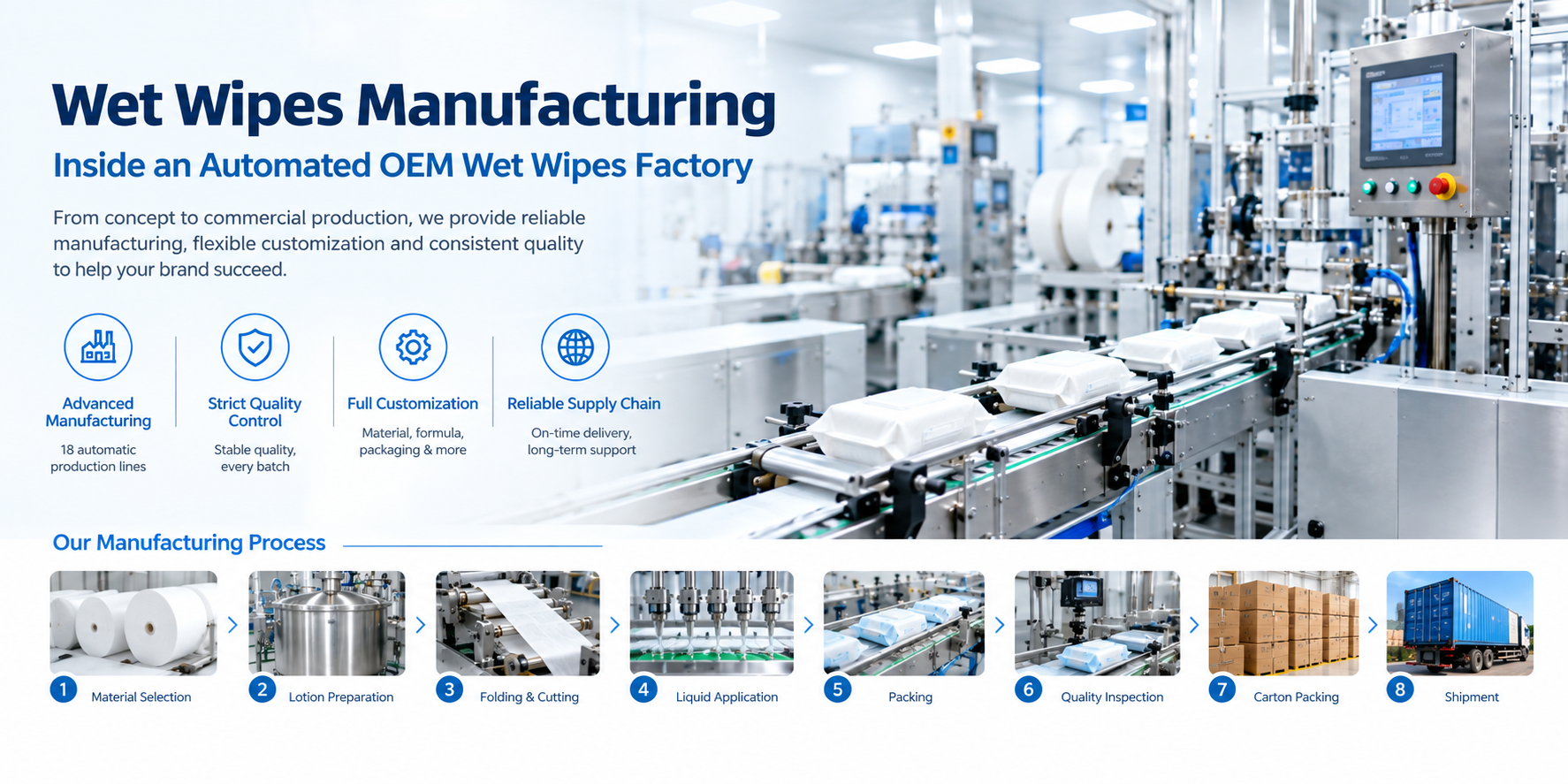
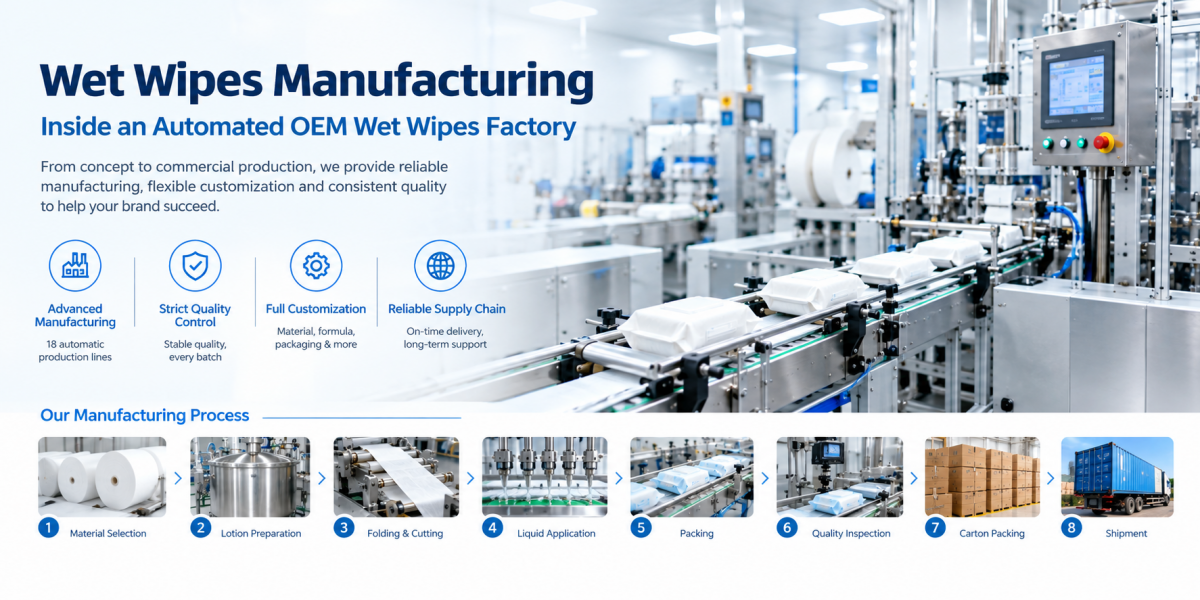
Biokleen’s facility is equipped with 18 automatic wet wipes production lines. According to our current production capabilities, the facility can produce approximately:
- 5,000,000 soft packs per month
- 2,000,000 canister wipes per month
- 500,000 big-roll gym wipes per month
This manufacturing capacity allows us to support different types of OEM projects, from personal care and baby wipes to pet wipes, disinfecting wipes, cleaning wipes and gym wipes.
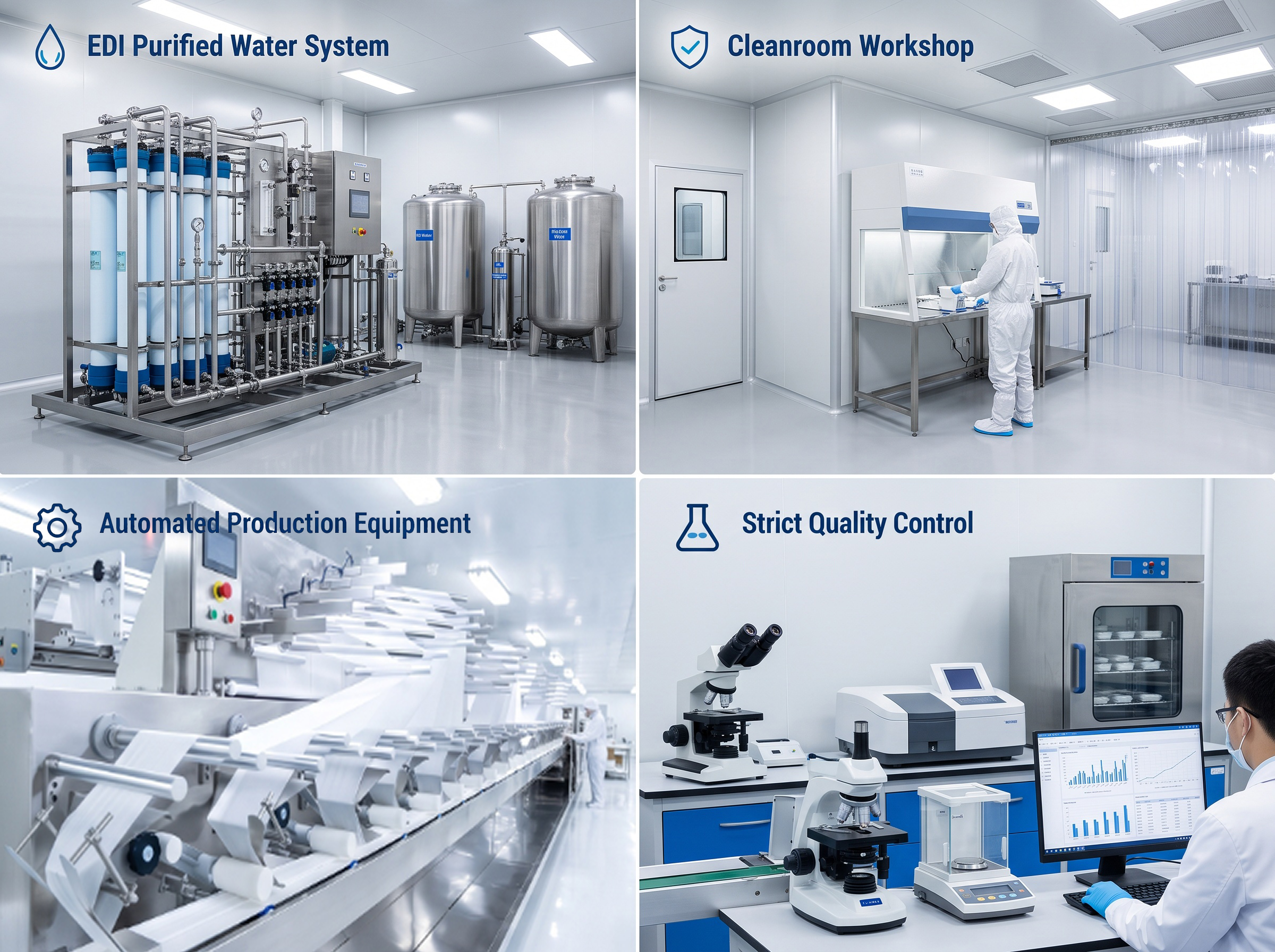
Automation plays an important role across the manufacturing process, including material feeding, folding, cutting, lotion application, counting, packing and sealing. Automated equipment helps reduce unnecessary manual variation and allows key product specifications to be controlled more efficiently.
For brands, this matters when moving from samples to commercial orders. A product that performs well in a small sample run must also be reproduced reliably when order quantities increase.
Our facility is also supported by a QC team with more than 10 years of experience, helping monitor product quality throughout the manufacturing process.
How Are Wet Wipes Manufactured?
The typical wet wipes manufacturing process can be summarized as:
Material Selection → Lotion Preparation → Folding & Cutting → Liquid Application → Packing → Quality Inspection → Carton Packing → Shipment
The first step is selecting the appropriate nonwoven material according to the intended application. Different products may require different fiber compositions, GSM, softness, strength and absorbency.
The lotion is then developed according to the product’s intended use. Depending on the project, brands may require moisturizing, cleansing, antibacterial, fragrance-free, plant-based or other specialized formulations.
The nonwoven material is folded and cut according to the required sheet size before the lotion is applied at a controlled level. The wipes are then counted and packed into the selected packaging format.
Quality inspections help monitor important characteristics such as sheet dimensions, moisture, appearance, sealing and packaging integrity.
However, manufacturing is only one part of a successful OEM project.
For many brands, the more important question is:
Can the manufacturer help develop the product in the first place?
OEM & Private Label Wet Wipes Customization
Many brands do not simply want an existing wet wipe with their logo added to the package. They want a product designed around their target market, application, positioning and customer expectations.
This is where OEM development becomes valuable.
Biokleen provides customization support for areas such as:
- Nonwoven material and GSM
- Sheet size and folding pattern
- Lotion formulation
- Fragrance or fragrance-free options
- Embossing and surface texture
- Wipe count per pack
- Soft packs and canisters
- Big-roll and refill formats
- Biodegradable and bamboo options
- Private label packaging and artwork
Our contract manufacturing service also includes an internal laboratory, experienced chemists and an in-house design team, allowing customers to receive support across formulation, packaging and product development.
This means a customer can start with an idea rather than a fully developed specification.
For example, a brand may know that it wants to launch a premium pet wipe, an outdoor biodegradable wipe or a heavy-duty gym cleaning wipe, but may not know which material, GSM, lotion or packaging format would be most suitable.
Our team can help evaluate those requirements and develop a practical specification.
The objective is not simply to manufacture the customer’s product. It is to help turn the product concept into a commercially viable wet wipes product.
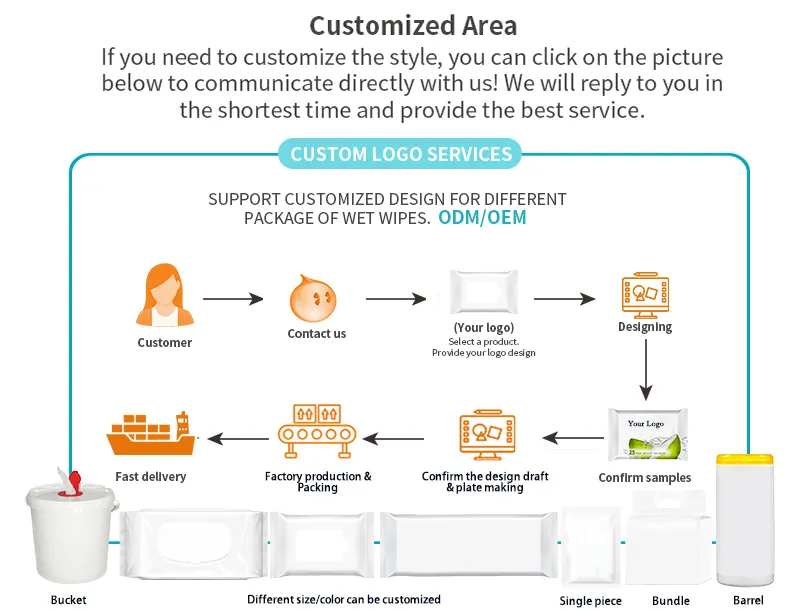
From Product Concept to Samples
A strong OEM project starts before mass production.
After receiving a customer’s requirements, our team can evaluate the intended application and recommend suitable options for the material, GSM, sheet size, lotion, fragrance and packaging.
The next step is sample development.
Samples allow brands to evaluate the finished product rather than judging individual specifications separately. Important factors can include:
- Softness and hand feel
- Sheet thickness
- Moisture level
- Lotion performance
- Fragrance
- Wet strength
- Folding
- Packaging and dispensing
This stage is particularly important because two wipes with the same GSM can still feel and perform differently. The final user experiences the combination of material, formula, liquid loading and packaging, rather than any single component alone.
For new brands, sampling also provides an opportunity to refine the product before committing to a larger order.
If adjustments are needed, specifications can be reviewed and samples developed further until the product meets the intended requirements.
From Approved Samples to Full-Scale Production
Once the product specifications and packaging artwork are approved, the project can move into full-scale manufacturing.
At this stage, the approved sample becomes the reference for the commercial product. Material specifications, formula, liquid loading, packaging and quality requirements all need to remain aligned with the agreed product.
This is particularly important for brands planning repeat orders.
A suitable OEM wet wipes manufacturer should not only be able to produce the first shipment. The supplier should also have the manufacturing capacity, quality systems and supply chain needed to support future growth.
Biokleen maintains supply chain relationships with more than 5 factories, while its purchasing and QC teams work to manage material sourcing, cost and quality. The company also has dedicated R&D and design capabilities for independent development and customization.
More Than a Wet Wipes Factory
The role of an OEM manufacturer has changed.
Brands today may need help with much more than filling and packing wipes. They may need assistance selecting the right substrate, developing a formula, adjusting the sensory experience, choosing packaging and preparing a product for a specific market.
That is why Biokleen’s OEM service focuses on formulation, packaging design and mutual product development.
Our internal laboratory and experienced chemists support formulation development, while our in-house design team can assist with packaging and the wider development process. Biokleen describes this approach as supporting customers from the initial idea through to delivery of the finished product.
For brands, this creates a more integrated development process:
Product Idea → Specification → Material & Formula Selection → Sample Development → Evaluation → Adjustment → Final Approval → Manufacturing
Instead of managing each stage with different suppliers, brands can work with one OEM partner throughout the project.
Your OEM Wet Wipes Partner
Choosing a private label wet wipes manufacturer means choosing a partner that can support both product development and commercial supply.
Biokleen combines 40 automatic production lines, large-scale manufacturing capacity, experienced QC, formulation support, packaging design and OEM customization to serve brands across different wet wipes categories.
From the first product concept to sample development and finally to full-scale manufacturing, our goal is to make the OEM process more efficient, flexible and practical for brands.
Your brand, our expertise — from product idea to finished wet wipes.