
 English
 French
 Russian
 Chinese (Simplified)
 Spanish
 German


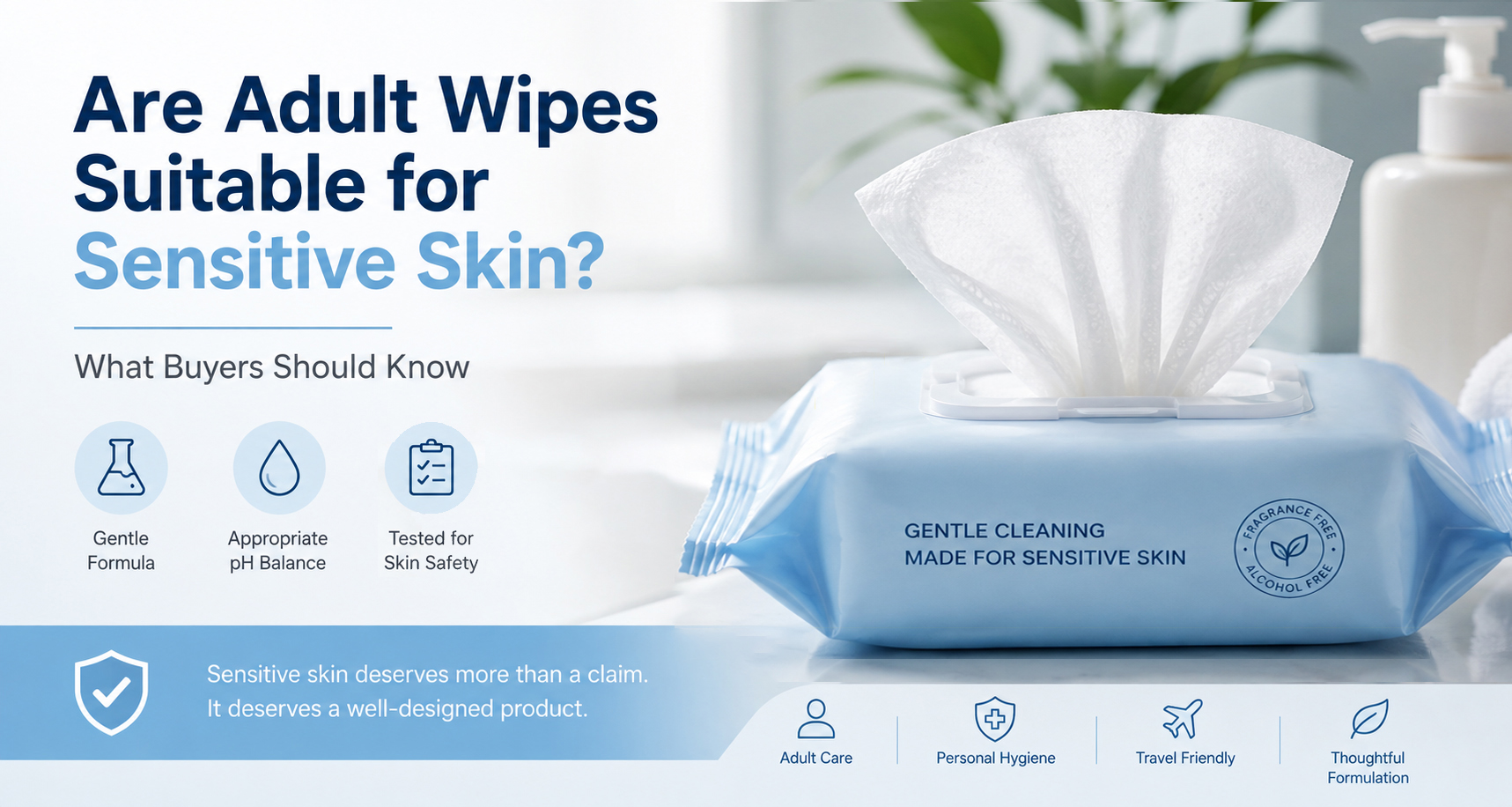
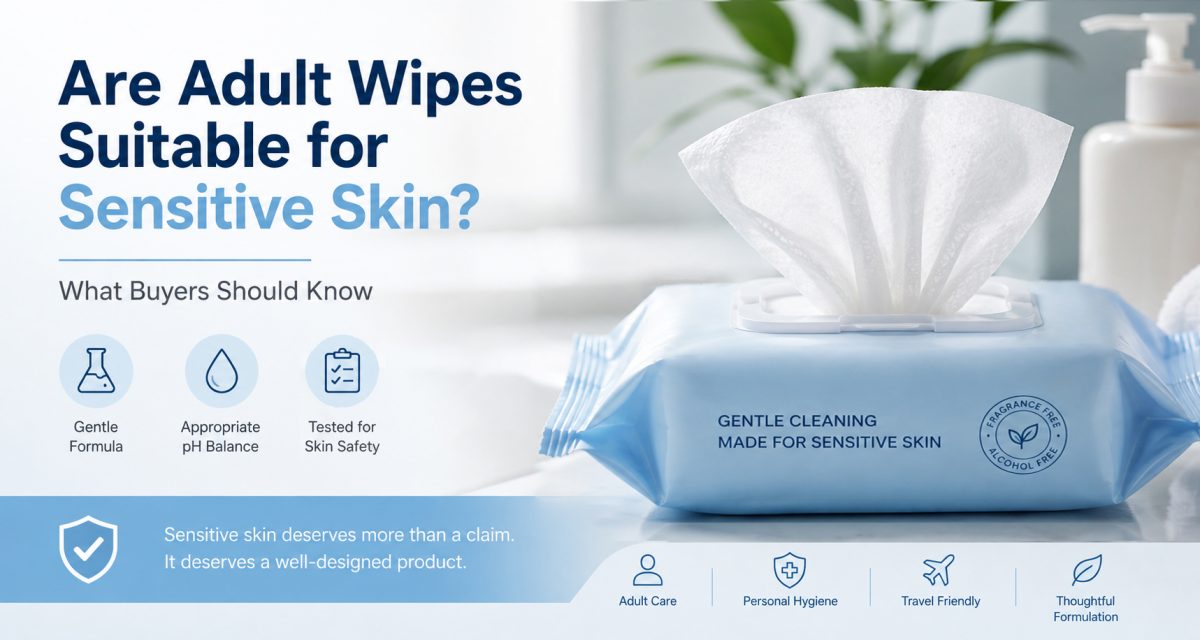
Are Adult Wipes Suitable for Sensitive Skin? What Buyers Should Know
Adult wipes are widely used for personal hygiene, body cleansing, adult care and situations where regular washing is not convenient. As consumers become more concerned about ingredients and skin comfort, one question is increasingly important for both users and private label brands:
Are adult wipes suitable for sensitive skin?
The answer is not simply yes or no.
A wipe may be labelled “gentle,” “hypoallergenic,” “alcohol-free” or “fragrance-free,” but none of these claims alone can determine whether the finished product will be suitable for every person with sensitive skin.
For adult wipes, skin suitability depends on the complete product system—including the formula, pH, preservative strategy, nonwoven material, intended use and the evidence supporting the product claim.
For private label buyers, this means developing a sensitive-skin adult wipe is more complex than simply removing fragrance from an existing formula.
Quick Answer:
Adult wipes can be suitable for sensitive skin when the complete product is designed for gentle cleansing and appropriate use. However, suitability depends on more than a single claim such as “hypoallergenic” or “alcohol-free.” The liquid formula, fragrance status, pH, preservative system, wipe material and intended application should all be considered.
A useful way to evaluate a sensitive-skin adult wipe is to focus on four areas:
- Formula– What ingredients are used, and why?
- pH and intended use– Is the product specification appropriate for how and where the wipe will be used?
- Substrate– How does the material feel and perform when wet?
- Testing and documentation– What evidence supports the product positioning?
The key principle is simple: sensitive-skin suitability should be evaluated as a property of the finished wipe—not as a single ingredient claim.
What Makes an Adult Wipe More Suitable for Sensitive Skin?
1. The Complete Formula Matters
When people think about sensitive-skin wipes, fragrance is often the first thing they consider.
Fragrance can be an important factor, particularly for consumers who prefer to avoid fragrance ingredients. However, fragrance is only one part of the formulation.
An adult wipe may also contain:
- Cleansing ingredients
- Humectants
- Preservatives
- pH-adjusting ingredients
- Botanical extracts
- Other functional ingredients
The role of each ingredient should be considered in relation to the finished product.
For example, a formula can be fragrance-free but still contain ingredients that may not be appropriate for every individual. Likewise, simply removing multiple ingredients from a formula does not automatically make a product better. Wet wipes contain a high percentage of water and require an effective preservation strategy to maintain product quality throughout their intended shelf life.
From a manufacturing perspective, the goal is not simply to create the shortest possible ingredient list.
The goal is to create a balanced formula that provides:
- Effective cleansing
- Appropriate skin feel
- Product stability
- Microbial control
- Compatibility with the nonwoven material
- Performance throughout the product’s intended shelf life
2. pH Should Be a Specification, Not Just a Marketing Claim
Terms such as:
“pH balanced”
“Skin-friendly pH”
“Gentle on skin”
sound reassuring, but they are not meaningful sourcing specifications by themselves.
The more useful questions are:
- What is the target pH range?
- What is the acceptable production tolerance?
- How is pH tested?
- Is it included in the finished-product specification?
The appropriate pH can depend on the intended application and where the wipe will be used.
For example, a general body cleansing wipe and a wipe developed for a more specific personal-care application may require different formulation considerations.
For B2B buyers, the important point is that if pH is part of the product positioning, it should be measurable and documented.
A product specification is stronger than a packaging slogan.
3. The Wipe Material Also Affects the User Experience
A common sourcing mistake is to evaluate the wipe primarily by GSM.
But GSM alone does not tell you whether a wipe will feel soft or gentle.
The skin feel of a nonwoven material can be influenced by:
- Fiber composition
- Fiber fineness
- Bonding method
- Surface texture
- Embossing
- Thickness
- Wet strength
- Liquid absorption and release
Two materials with the same GSM can feel very different during actual use.
One may feel soft when dry but become less comfortable after saturation. Another may be thinner but release liquid more effectively and require less wiping pressure.
This is why manufacturers and buyers should evaluate the finished wet wipe, not only the dry material sample.
Does Higher GSM Mean a Gentler Wipe?
No. Higher GSM describes material weight, not skin compatibility.
A higher basis weight may affect thickness, absorbency and perceived quality, but it does not independently determine:
- Softness
- Surface friction
- Wet feel
- Ease of wiping
A better sourcing question is:
How does this material perform when wet, and how does it feel during repeated use?
4. Testing and Documentation Matter
A sensitive-skin product claim should not rely entirely on subjective descriptions such as:
“It feels gentle.”
For private label buyers, it is important to understand what evidence supports the product positioning.
Depending on the product, intended use and target market, relevant evaluation may include:
- Skin compatibility testing
- Stability testing
- Microbiological testing
- Product safety assessment
- Material documentation
- Claim substantiation
These types of evidence are not interchangeable.
For example, a certification relating to the nonwoven material does not automatically prove that the complete wet wipe is suitable for sensitive skin.
The finished product includes:
Formula + Nonwoven + Liquid Loading + Packaging
Each of these elements can influence the final result.
Buyer rule: Ask what was tested, what the test was designed to evaluate and whether the evidence relates to the finished product.
Adult Wipes vs. Baby Wipes: Which Is Better for Sensitive Skin?
Many consumers assume that baby wipes are automatically the better choice for sensitive adult skin.
That is not always the case.
Neither adult wipes nor baby wipes are automatically better for sensitive skin. The better choice depends on the formulation and intended use.
| Factor | Baby Wipes | Adult Wipes |
| Typical use | Infant cleansing and diaper changes | Body cleansing, personal hygiene or adult care |
| Sheet size | Usually smaller | Often larger for greater coverage |
| Material focus | Softness and frequent use | Balance of softness, strength and coverage |
| Formula | Designed around infant care requirements | Depends on the specific application |
| User needs | Gentle cleansing | May include adult care, frequent use or larger-area cleansing |
The category name alone does not determine whether a product is suitable for sensitive skin.
An adult wipe can be specifically developed with a fragrance-free formula and a soft nonwoven material.
At the same time, different adult wipe applications may require different product characteristics.
For example, an adult care wipe may need:
- A larger sheet
- Higher wet strength
- Better liquid retention
- A specific cleansing performance
- A softer material for frequent use
This is why copying a baby wipe formula into an adult wipe is not always the best development strategy.
The right question is not “Should we use a baby wipe formula?” but “What does this adult wipe need to do, and how will it be used?”
How Should Private Label Buyers Choose Sensitive-Skin Adult Wipes?
A common mistake is to start product development with a marketing request:
“We need sensitive-skin adult wipes.”
That description is not enough to create a clear manufacturing specification.
A better process starts with four questions.
1. Who Will Use the Product?
The target user may be:
- General adult consumers
- Seniors
- Adult care users
- Frequent users
- Consumers specifically looking for sensitive-skin products
Understanding the user helps determine the required product experience.
2. How Will the Wipe Be Used?
The intended application could include:
- General body cleansing
- Personal hygiene
- Adult care
- Travel
- Post-workout use
The use case affects decisions about:
- Sheet size
- Formula
- Cleansing performance
- Material strength
- Liquid loading
- Packaging
A wipe designed for occasional body cleansing may have different requirements from one designed for frequent adult care.
3. What Does “Sensitive Skin” Mean for This Product?
Buyers should define the actual product requirements instead of relying on the phrase alone.
For example:
- No added fragrance?
- Alcohol-free?
- A defined pH range?
- A specific ingredient preference?
- Dermatological or skin compatibility testing?
- A particularly soft substrate?
The manufacturer can then develop the product around measurable specifications rather than a vague marketing concept.
4. What Evidence Will Support the Final Claim?
Before finalizing packaging, the buyer should ask:
- What claim will appear on the product?
- What evidence supports that claim?
- What documentation is available?
- What requirements apply in the target market?
A strong development process connects:
Product Claim → Formula → Testing → Documentation → Packaging
When these steps are disconnected, problems can appear later—particularly when a brand needs to explain or defend its product positioning.
A Simple Buyer Decision Framework
When comparing adult wipe suppliers, buyers can use the following questions.
| What to Ask | What a Strong Answer Looks Like |
| What ingredients are used? | Clear ingredient information and an explanation of key functions |
| Is the product fragrance-free? | A clear distinction between fragrance-free and unscented |
| What is the pH specification? | A defined target range and production testing approach |
| What material is used? | Fiber composition, GSM and expected wet performance |
| How is microbial quality managed? | A clear explanation of preservation and hygiene controls |
| What supports the product claim? | Relevant testing, documentation or a clear substantiation pathway |
| How is consistency maintained? | Documented specifications and production quality controls |
This approach often reveals more about a supplier than simply comparing price and MOQ.
Price tells you what the product costs. Specifications and documentation tell you what you are actually buying.
The Finished Product Matters More Than Individual Components
One of the most important lessons in wet wipes development is that the consumer does not experience the formula and material separately.
They experience:
Formula + Material + Liquid Loading + Packaging
as one finished product.
For example, changing the nonwoven material can affect:
- Liquid absorption
- Liquid release
- Surface feel
- Wiping friction
- Overall product performance
Changing the liquid loading can also influence:
- How wet the wipe feels
- How easily it cleans
- How much wiping pressure is needed
- Product weight
- Packaging performance
This is why approving a formula based only on a laboratory liquid sample is not enough.
The final product should be evaluated in its intended substrate and packaging format.
From a manufacturing perspective, the best formula on paper is not necessarily the best-performing finished wipe.
The Bottom Line
Adult wipes can be suitable for sensitive skin, but no single label—such as “gentle,” “hypoallergenic,” “alcohol-free” or “fragrance-free”—can define the suitability of the complete product.
For private label buyers, the most important factors to evaluate are:
- The complete formula
- Fragrance status
- pH specification
- Preservative strategy
- Nonwoven material and wet performance
- Intended use and target user
- Testing and claim substantiation
- Manufacturing consistency
The most useful question to ask a manufacturer is not:
“Is this wipe gentle?”
It is:
“How was this wipe designed for sensitive-skin positioning, and what specifications or evidence support that?”
The answer will tell you far more about the product than a marketing claim on the packaging.
Frequently Asked Questions
Are fragrance-free adult wipes better for sensitive skin?
Fragrance-free adult wipes may be a preferred option for consumers who want to avoid added fragrance ingredients. However, fragrance-free does not guarantee that a product will be suitable for every individual. The complete formula, intended use and individual sensitivity should also be considered.
Does alcohol-free mean an adult wipe is gentler?
Not necessarily. Alcohol-free describes one aspect of a formulation. Other ingredients, the cleansing system, the intended application and the condition of the user’s skin can also influence the overall experience.
What should private label buyers check before sourcing sensitive-skin adult wipes?
Buyers should review the complete formula, fragrance status, pH specification, preservative strategy, fiber composition, wet performance, relevant testing and documentation, and the manufacturer’s ability to maintain consistent specifications during mass production.
Developing a Sensitive-Skin Adult Wipes Project?
If you’re looking to develop private label adult wipes for sensitive-skin positioning, our team can help you evaluate the key product factors—from formula and fragrance requirements to nonwoven material, sheet size, liquid loading and packaging.
Share your product requirements with us, and we’ll help you explore a suitable specification for your market.