
 English
 French
 Russian
 Chinese (Simplified)
 Spanish
 German


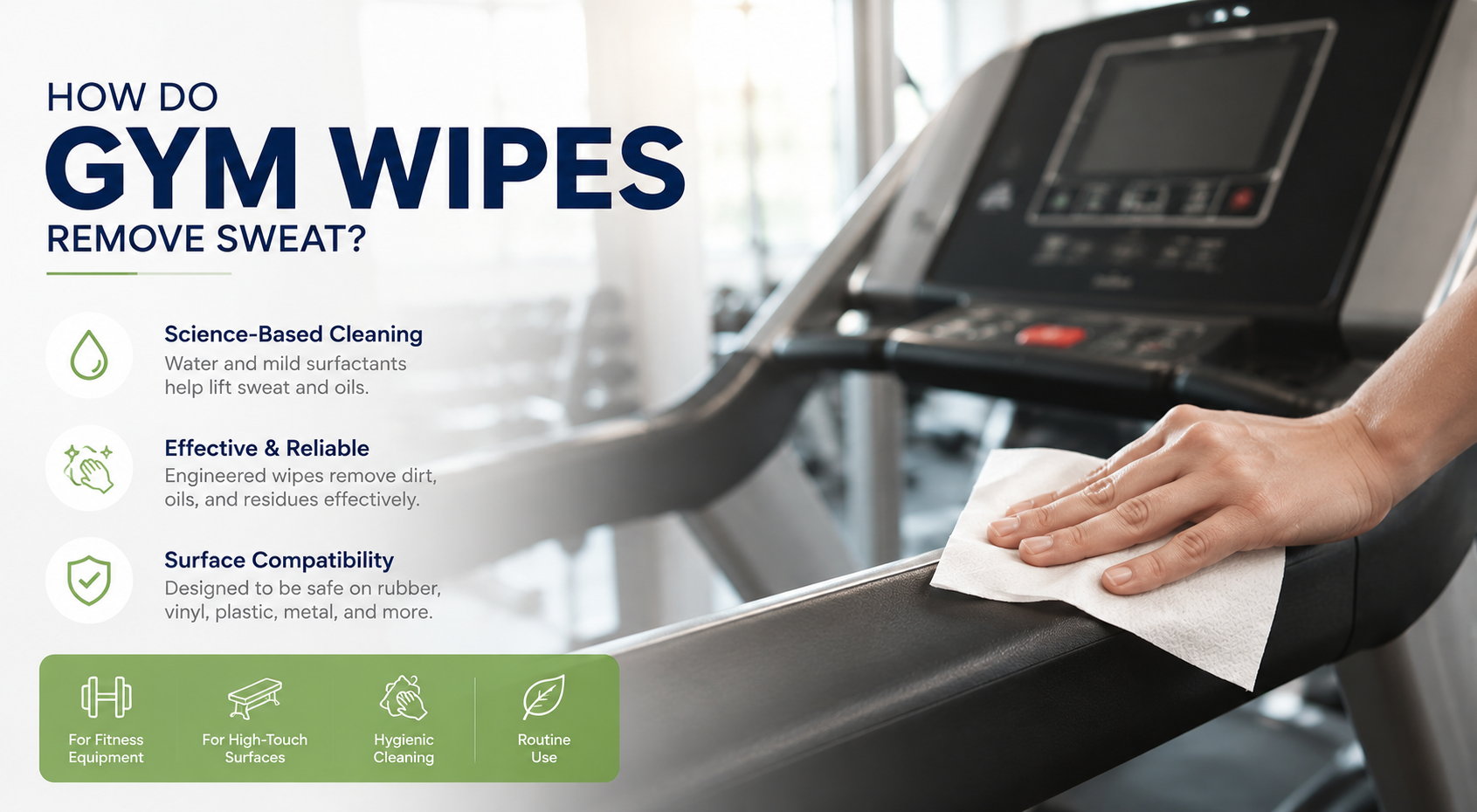
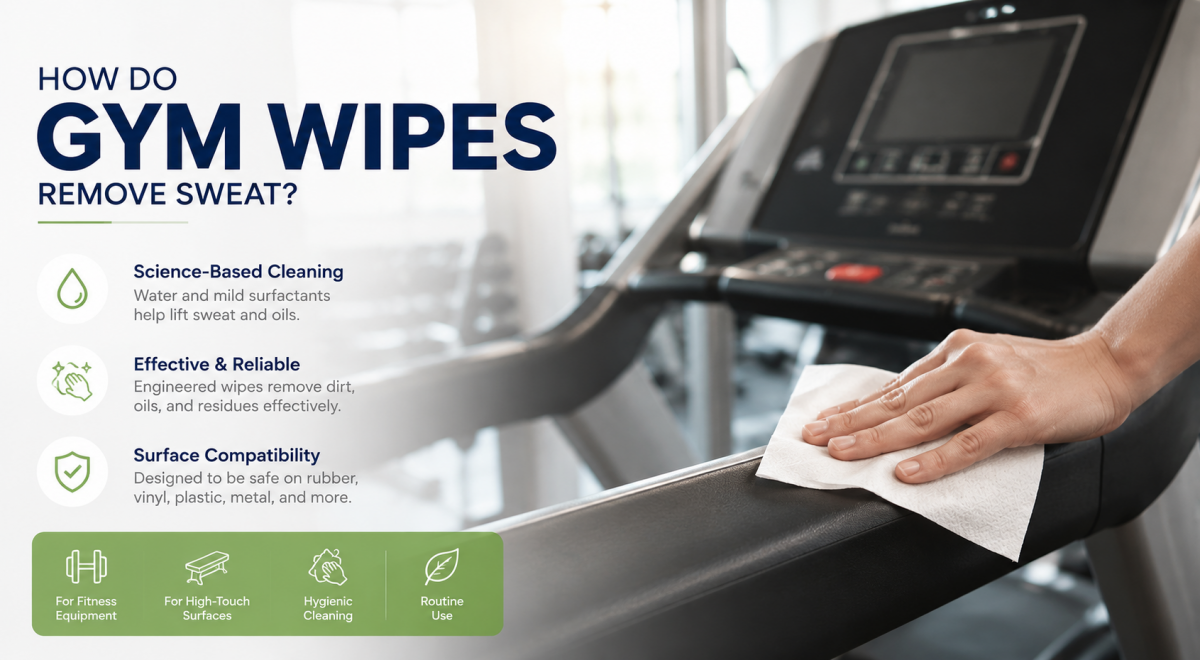
Gym wipes remove sweat, body oils, dirt, and surface residues through a combination of water, mild surfactants, and mechanical wiping. The challenge is achieving effective cleaning without creating unnecessary risks for rubber, vinyl, plastic, metal, or coated surfaces.
For fitness centers, distributors, and private-label brands, the right gym wipes should balance cleaning performance, surface compatibility, and repeated-use requirements.
Quick Answer: How Do Gym Wipes Remove Sweat?
Gym wipes remove sweat through three mechanisms: water loosens water-soluble residues, mild surfactants help lift oils and organic contamination, and the nonwoven substrate physically removes the loosened residues.
A well-designed wipe also needs to consider pH, residue, corrosion protection, liquid loading, and material compatibility.
The goal is not the strongest possible cleaning action, but effective cleaning with appropriate surface protection.
What Makes Sweat Difficult to Remove?
Sweat is mainly water, but it also contains salts and other components. During exercise, equipment can accumulate body oils, skin residues, dust, and other contaminants.
These residues commonly build up on:
- Machine handles and grips
- Weight benches
- Dumbbells
- Vinyl upholstery
- Plastic components
- Metal frames
- Touchscreen consoles
Because of this, water alone may not provide sufficient cleaning. A gym wipe needs to loosen contamination and physically remove it from the surface.
How Do Gym Wipes Remove Sweat?
Three factors work together.
1. Water loosens water-soluble residues
Water is the main carrier in most wet wipes. It helps loosen and dissolve water-soluble components of sweat.
2. Mild surfactants help lift oils
Surfactants help the cleaning solution interact with body oils and other organic residues.
APG (alkyl polyglucoside) can be used as a mild surfactant in routine-cleaning formulations, providing cleaning performance without relying on an overly aggressive detergent system.
3. The nonwoven physically removes contamination
The wiping action is equally important.
As the wipe moves across the equipment, the nonwoven substrate collects and removes the loosened contamination.
This means cleaning performance comes from:
Cleaning formula + nonwoven substrate + wiping action
—not the liquid formula alone.
What Ingredients Matter in Gym Wipes?
There is no single formula suitable for every gym wipe. The formulation should be developed according to the equipment, cleaning target, and intended market.
A mild routine-cleaning formulation may include:
| Ingredient | Main function |
| Deionized water | Carrier and solvent |
| APG surfactant | Helps remove oils and organic residues |
| EDTA-2Na | Helps manage mineral ions and residues |
| Corrosion inhibitor | Supports metal surface protection |
| Preservative system | Helps maintain product stability |
The ingredients should work as a formulation system, rather than being evaluated individually.
For example, APG supports the main cleaning function, while EDTA-2Na and a corrosion inhibitor can support residue management and surface protection.
Can Gym Wipes Damage Equipment?
Yes. An incompatible formulation may affect equipment surfaces, especially with repeated use.
Gym equipment can contain multiple materials, including:
- Rubber
- Vinyl
- Plastic
- Metal
- Powder-coated surfaces
- Painted surfaces
- Acrylic
- Electronic displays
Surface compatibility depends on both the formulation and the material being cleaned.
A formula that works well on stainless steel may not provide the same compatibility with rubber, vinyl, plastic, or coated surfaces.
Potential concerns include residue, discoloration, tackiness, coating changes, or corrosion.
For this reason, gym wipes should be evaluated against the actual materials used in the target equipment.
What pH Should Gym Wipes Have?
There is no universal “best” pH for all gym wipes.
For some mild routine-cleaning formulations, pH 6.5–7.5 can be a practical development range because it provides a near-neutral starting point.
However, pH alone does not determine surface safety.
The complete formula, ingredient concentrations, contact conditions, residue, and material compatibility all matter.
A better evaluation is:
pH + formulation + contact conditions + surface compatibility
Why Does Repeated Use Matter?
Gym equipment may be wiped several times a day, making repeated exposure more important than a single cleaning test.
A formula that appears acceptable after one application may behave differently after many cleaning cycles.
Manufacturers should therefore evaluate:
- Surface appearance
- Residue
- Material changes
- Corrosion
- Coating compatibility
- Cleaning performance
For commercial gym wipes, long-term compatibility should be considered alongside immediate cleaning performance.
How Should Gym Wipes Be Tested?
For B2B buyers, one key question is whether the finished wipe—not just the liquid formula—has been evaluated.
A practical evaluation should include:
Cleaning performance
Can the wipe remove sweat, oils, and dirt effectively?
Surface compatibility
Is it suitable for the intended rubber, vinyl, plastic, metal, or coated surfaces?
Repeated-use exposure
Does the surface remain stable after repeated cleaning?
Residue and appearance
Does the wipe leave streaks, stickiness, or visible residue?
This matters because changing the nonwoven substrate or liquid loading can change the performance of the finished wipe, even when the formula remains the same.
What Should B2B Buyers Look for in Gym Wipes?
When sourcing gym wipes in bulk or developing a private-label product, consider more than the unit price.
Cleaning performance
Can it effectively remove sweat and body oils?
Surface compatibility
Has the finished wipe been evaluated against the target equipment materials?
Nonwoven substrate
Is it strong and absorbent enough for repeated wiping?
Liquid loading
Does it provide enough moisture without excessive dripping or residue?
Sheet size
Is it appropriate for the equipment and cleaning area?
Packaging
Does the bucket, roll, or dispensing format suit the facility’s usage?
Manufacturer capability
Can the supplier customize the formula, substrate, liquid loading, size, and packaging?
A capable gym wipes manufacturer should be able to develop the complete finished wipe, not simply supply a cleaning formula.
How Are Private Label Gym Wipes Developed?
A practical OEM/ODM process usually follows:
Application → Formula → Nonwoven → Liquid Loading → Testing → Packaging
The process starts by identifying the equipment, target surfaces, and cleaning requirements. The formulation and nonwoven substrate are then developed accordingly.
The finished wipe is evaluated for cleaning performance, surface compatibility, and user experience before the packaging is finalized.
This application-first approach allows private-label gym wipes to be adapted to different equipment, usage frequencies, and dispensing formats.
FAQ: Gym Wipes
1. How do gym wipes remove sweat?
Gym wipes use water, mild surfactants, and mechanical wiping to loosen and remove sweat, body oils, and other surface residues.
2. Are gym wipes safe for gym equipment?
They can be when properly formulated and tested for the intended equipment materials. Rubber, vinyl, plastic, metal, and coated surfaces may require different compatibility considerations.
3. Can gym wipes damage rubber or vinyl?
An unsuitable formulation may affect rubber or vinyl after repeated exposure. Finished-wipe compatibility testing is recommended.
4. What pH should gym wipes have?
There is no universal pH requirement. A range around 6.5–7.5 may be suitable for some mild cleaning formulations, but pH alone does not determine surface compatibility.
5. What should I ask a gym wipes manufacturer?
Ask about the formula, nonwoven substrate, liquid loading, surface compatibility testing, sheet size, packaging, MOQ, and customization capabilities.