
 English
 French
 Russian
 Chinese (Simplified)
 Spanish
 German


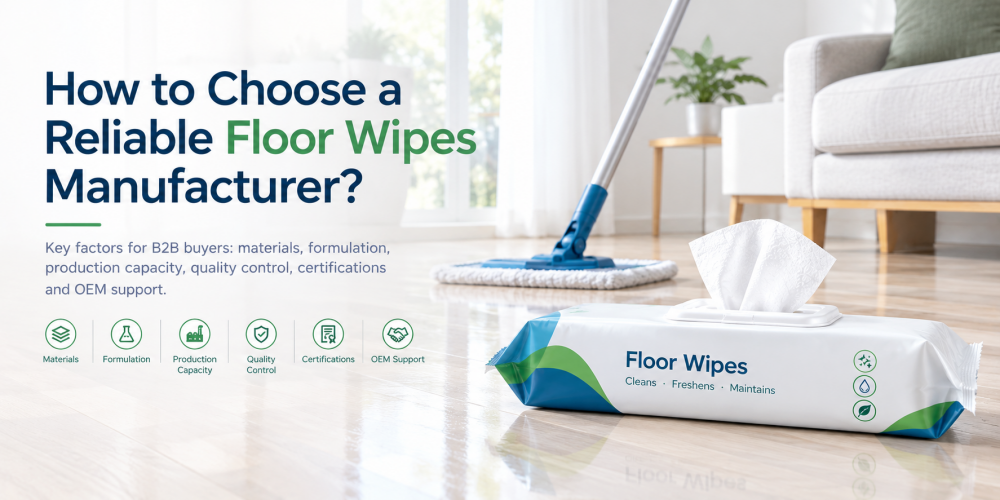
Choosing a floor wipes manufacturer is not simply about finding a factory with the lowest quotation. For brands, importers, distributors, and retailers, the bigger challenge is finding a supplier that understands how substrate, GSM, liquid loading, formula, sheet size, and packaging work together in a floor-cleaning product.
A suitable floor wipe should clean effectively, remain strong when wet, distribute liquid evenly, and leave an appropriate finish on the target floor surface. The manufacturer behind it needs to understand all of these factors.
Here are the key points B2B buyers should consider.
1. Define the Floor Wipe You Actually Need
Before asking for quotations, define how the floor wipe will be used.
Consider:
- Target floor surfaces
- Sheet size
- GSM
- Sheets per pack
- Folding method
- Formula
- Fragrance
- Packaging
- Target price
- Expected order volume
Large-format wipes such as 40 × 60 cm are suitable for mop-style cleaning applications in some markets, while smaller formats may be designed for hand cleaning or smaller areas.
The pack count also depends on the sales channel. For example, a 10-sheet pack can work well as a convenient trial or retail format, while larger packs may be more suitable for regular household use.
If you are unsure about the specifications, an experienced custom floor wipes manufacturer should help you develop the product instead of simply asking you to choose from a standard catalog.
2. Choose the Right Substrate, GSM and Wet Strength
The substrate is particularly important for floor moist wipes because the wipe needs to absorb cleaning liquid while remaining strong during use.
Common options include viscose + polyester spunlace, wood pulp blends, and 100% viscose.
For example, viscose can provide good absorbency, while polyester can improve wet strength. This balance can be useful when the wipe is saturated with liquid and pressed against a floor surface.
What GSM Is Suitable for Floor Cleaning Wipes?
For most floor cleaning wipes, around 50–80 GSM is a practical range for many applications. Lighter substrates can be suitable for everyday or light-duty cleaning, while higher GSM within this range can provide a thicker, more substantial wipe with greater material strength and liquid-holding capacity.
However, GSM should not be selected on its own. The final specification also depends on the nonwoven composition, wipe size, liquid loading, wet strength requirements, and intended cleaning method. For OEM floor wipes, the most suitable GSM is usually determined by balancing cleaning performance, user experience, and target product cost rather than simply choosing the heaviest substrate.
3. Match the Formula to the Floor Surface
A floor wipe formula should be developed for the specific surface it is intended to clean. Using one formula for every floor type can lead to streaks, residue, slow drying, or potential surface damage.
| Floor Surface | Cleaning Goals | Formula Attributes | Moisture Control | Main Risks |
| Tile & Vinyl | Dirt & grease removal | Effective surfactants; balanced pH | Moderate moisture; normal drying | Slippery residue; streaks |
| Wood & Laminate | Gentle, streak-free cleaning | Low-residue; neutral pH; quick-dry | Low moisture; fast drying | Swelling; residue buildup |
Regulatory & Claims Note: If your brand plans to make claims such as “disinfects,” “sanitizes,” or “kills bacteria,” additional regulatory requirements and efficacy testing may apply depending on the target market. In the US, certain antimicrobial claims for floor wet wipes may fall under EPA pesticide registration requirements, while biocidal products and certain treated articles in the EU are regulated under the Biocidal Products Regulation (BPR).
An experienced floor cleaning wipes manufacturer should be able to adjust the formula, pH, surfactant system, and moisture level according to the target floor surface and product positioning.
4. Pay Attention to Liquid Loading and Packaging
One factor that is sometimes overlooked when sourcing floor wet wipes is liquid loading.
A wipe that is too dry may not provide sufficient cleaning performance. On the other hand, excessive liquid can make the floor unnecessarily wet, increase drying time, and potentially create packaging or leakage issues.
The goal is to achieve an appropriate balance between:
Liquid loading + absorbency + cleaning performance + drying time
Packaging also matters. Floor wipes may be packed in resealable flow packs, bags, or other formats depending on the product design.
B2B buyers should check whether the packaging protects the wipes from drying out and whether the carton configuration is efficient for transportation.
5. Test the Manufacturer’s OEM Capability
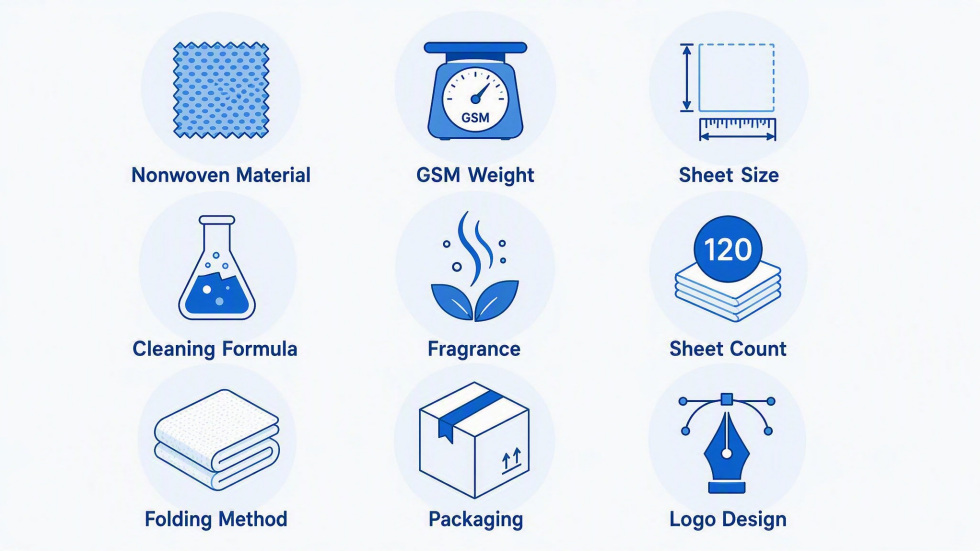
For a private label floor cleaning wipes project, the manufacturer’s OEM capability can directly affect the final product.
Ask whether the supplier can customize:
- Nonwoven material
- GSM
- Sheet size
- Formula
- Fragrance
- Sheet count
- Folding method
- Packaging
- Logo and artwork
More importantly, look at how the manufacturer handles product development.
If your target price is too high, can they recommend a more cost-effective substrate? If the wipe leaves residue, can they adjust the formula? If you need a different mop-compatible size, can they modify the production specification?
With 20+ years of wet wipes OEM experience, Biokleen Wipes supports product development from material and formula selection through customized packaging and mass production.
6. Compare MOQ, Cost and Supply Reliability
Once the product specification is confirmed, compare suppliers based on the complete quotation.
Floor wipe costs can vary depending on:
- Material
- GSM
- Sheet size
- Formula
- Sheet count
- Packaging
- Carton configuration
- MOQ
- Shipping terms
Do not compare only the FOB price.
For example, a lower-priced wipe may use a different GSM or material, making the comparison inaccurate. Always make sure suppliers are quoting against the same specifications.
You should also confirm the manufacturer’s production capacity and lead time.
A supplier may be suitable for a trial order but unable to maintain supply when your sales increase. For retail and distribution projects, consistent repeat production is just as important as the first shipment.
7. Test the Product Before Mass Production
Before committing to a large order, conduct a proper sample evaluation.
For pre-moistened floor wipes, test them on the actual surfaces they are designed for and check:
- Cleaning performance
- Wet strength
- Absorbency
- Liquid distribution
- Drying time
- Residue
- Lint
- Fragrance
- Packaging performance
If you already have a successful reference product, send it to the manufacturer.
A capable OEM supplier should be able to analyze the reference sample and help identify the appropriate combination of substrate, GSM, formula, liquid loading, and packaging.
The goal is not simply to copy a sample. It is to develop a product that meets your market requirements while remaining commercially viable.
FAQ
What material is best for disposable floor wipes?
There is no single best material for every wet floor wipes. Viscose + polyester spunlace is a practical option because it can balance absorbency and wet strength. Wood pulp blends and 100% viscose may also be suitable depending on the application.
What size are moist floor wipes usually?
Floor wipe sizes vary by application. Large formats such as 40 × 60 cm are suitable for many mop-style cleaning applications, while smaller formats may be used for hand cleaning or compact cleaning tools. Biokleen supports standard sizes as well as fully customized dimensions. Contact our team to get a standard sample.
What GSM is suitable for floor wipes?
The appropriate GSM depends on the required wet strength, absorbency, cleaning performance, and target cost. Higher GSM is not automatically better; the substrate and liquid loading should be considered together.
Can cleaning wipes for floor be used on wood and laminate floors?
Yes. Wood floor wipes can be specifically formulated for wood and laminate surfaces. The key is to control the formula, moisture level, and residue. Low-residue formulas with controlled liquid loading help reduce excess moisture and support a clean, streak-free finish, making them more suitable for wood and laminate flooring.
Final Thoughts
A good floor wipes manufacturer should understand much more than how to produce a wet wipe.
For B2B buyers, the key is finding a supplier that can connect material, GSM, wet strength, liquid loading, formula, floor compatibility, packaging, and production cost into one commercially viable product.
The right OEM partner can help you move from a basic product idea to a floor wipe that performs consistently in real-world use and can be reproduced reliably for future orders.
With more than 20 years of OEM experience, Biokleen Wipes can support private label floor wipes projects from product development and material selection to formula customization, packaging, sampling, and mass production.